
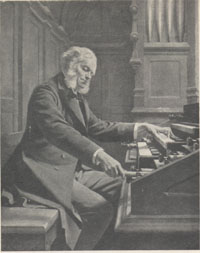
After his schooling, Franck chose to settle in Paris. He was made organist of St. JeanSt. François in 1853, and in 1858 he became organist of Saint Clothilde, a post he held until his death. He succeeded his teacher, Benoist, at the Paris Conservatory in 1872, teaching such illustrious students as Vincent d'Indy, Duparc, Chapuis, and Louis Vierne.
At this time France's musical front was torn between intense nationalism and a love for the romanticism of the Germans. Franck sought to bridge that gap, unlocking a new era in French organ music. He based his counterpoint on that of Bach, always striving for the ideal of Absolute Music. His melodies are generally small in range, but are accompanied by thick harmonies. Many of his pieces evolved from improvisations on the organ at St. Clothilde, yet they are clearly form-oriented and beautifully poetic. These characteristics pertain particularly to his Three Chorales. These works, each of which includes a chorale-like section, are mainstays in the repertoire of modern organists.